| Authors | Year | Analysed Theoretical Features of Fiscal Federalism | Major Findings (not quoted in the Text) | C (1) | DEC | |
|
I: Optimal Conside- ration of Hetero- geneous Regional Prefe- rences |
Färber | 2001 | Optimal consideration of
heterogeneous regional preferences, development of regionally diversified
”production structures”. Advantages of ”public administration federalism” |
The administrative jurisdictions should have the possibility to differentiate their supply regarding the existing regional preferences: efficiency gains because of bundling and local information retrieval at a lower price. | X | |
| Smekal | 2001 | Optimal consideration of heterogeneous regional preferences | X | |||
| Zimmermann
Henke |
2001 | Preference revealing problem | Because of the distance of the central level to local preference revelation, information, transaction, control or frustration costs could arise. Hint: fiscal illusions | X | ||
| Thießen | 2000 | Decentralisation Theorem | X | |||
| Andersson
Hårsman Quigley |
1997 | Optimal consideration of heterogeneous regional preferences – linkage to the Theory of Public Goods | X | |||
| Hemming
Spahn |
1997 | Preference revealing problem, Model of Tiebout | x | X | ||
| Ter-Minassian | 1997 | Correspondence of expenditure priorities with local preferences | Decentralisation of expenditure responsibilities should in principle lead to allocative efficiency gains. These gains may be negated by administrative weaknesses at the sub-national level. | X | X | |
| Alesina Perotti Spolaore |
1995 | Efficient provision of bundles of public goods in different localities | Differentiated bundles and costless individual mobility allow efficient provision of public goods in a decentralised country | X | ||
| Tanzi | 1995 | Decentralisation theorem and correspondence principle. | X | |||
| Cremer Estache Seabright |
1994 | Comparative advantages in accounting of the diversity of preferences | X | |||
| Oates | 1972 | Optimal consideration of heterogeneous regional preferences: decentralisation theorem, correspondence principle | X | |||
| Tiebout | 1956 | Optimal consideration of heterogeneous regional preferences: introducing mobility of citizens. | X | |||
|
II: Realisation of Economics of Scale, Internalisation of External Effects |
Behnisch Buettner Stegarescu |
2001 | Spill-over effects between jurisdictions and economic integration | Necessity of central co-ordination in order to internalise externalities. Consequently, efficiency gains and positive impacts on productivity growth can be realised by centralising several policy patterns. | X | |
| Eichenberger
Hosp |
2001 | Realisation of Economics of Scale Internalisation of external effects | X | |||
| Färber | 2001 | Minimization of transaction costs and internalisation of external effects | Necessity of certain central regulations in order to realise efficiency gains. | X | ||
| Hooghe
Marks |
2001 | Externalities and inter-jurisdictional co-operation | Distinction between two
types of multi-level governance in the context of dispersion of authority:
- Diminution of co-ordination costs by limiting the number of jurisdictions, setting up multi-task, general-purpose jurisdictions with non-overlapping territorial borders (Type I governance) - Limitation of spill-over among jurisdictions by compartmentalising: a large number of (overlapping) jurisdictions is spawned while co-ordination is minimised among them (Type II governance) |
X | X | |
| Smekal | 2001 | Realisation of Economics
of Scale Internalisation of external effects |
X | |||
| Schneider
Wagner |
2000 | Transaction, co-ordination and negotiation costs | X | |||
| Vukovich | 2000 | Realisation of Economics
of Scale Internalisation of external effects |
X | |||
| Hemming
Spahn |
1997 | Transaction, co-ordination and negotiation costs | Co-ordination can be tailored to specific functions and does not need a comprehensive regional approach. A supranational government will only play a catalytic role in such arrangements. | X | x | |
| Thomas | 1997 | Decentral policy failure, regulatory federalism paradigm | Development of a necessary condition for centralisation decisions. | X | ||
| Olson | 1969 | Transaction, co-ordination and negotiation costs | A decentralised pareto-optimal solution seems to be implausible. | X | ||
|
III: Inter- juris- dictional Compe- tition, Division of Labour |
Von Hagen | 2002 | Functional Federalism: overlapping jurisdictions | X | ||
| Smekal | 2001 | Inter-jurisdictional competition and enforcement of innovations Functional Federalism: overlapping jurisdictions | x | X | ||
| Eichenberger
Hosp |
2001 | Inter-jurisdictional competition and enforcement of innovations Functional Federalism: overlapping jurisdictions | X | |||
| Zimmermann
Henke |
2001 | Tax competition and segregation tendencies | X | |||
| Frey
Eichenberger |
1999 | Development of the Model of Functional, Overlapping and Competing Jurisdictions | ||||
| Henke
Perschau |
1999 | Tax competition and sub-optimal allocation of resources | X | |||
| Andersson
Hårsman Quigley |
1997 | Comparative advantages Functional Federalism: overlapping jurisdictions | X | |||
| Thomas | 1997 | Functional Federalism: overlapping jurisdictions | X | X | ||
| Cremer Estache Seabright |
1994 | Comparative advantages | X | |||
|
IV: Politico- economic Variables |
Eichenberger
Hosp |
2001 | Enforcement of democratic control and political information | X | ||
| Thießen | 2001 | Leviathan-behaviour, central policy failure, bureaucratic quality | X | |||
| Andersson
Hårsman Quigley |
1997 | Increasing institutional
complexity hampers decision structures, flexibility in local administration |
x | X | ||
| Thomas | 1997 | Leviathan-behaviour, central policy failure | X | |||
| Persson Roland Tabellini |
1996 | Second best effects of centralisation, effects on coalition formation | ||||
| Tanzi | 1995 | Corruption, bureaucratic quality | X | X | ||
| Oates | 1995 | Bureaucratic quality | X | |||
| Prud’homme | 1994 | Corruption, bureaucratic quality | X | |||
| Brennan
Buchanan |
1980 | Leviathan-behaviour, central policy failure | As long as decentralisation spreads the power of government among numerous and small lower tiers, the danger of an excessive tax burden diminishes. | X | ||
|
V: Geo- graphy and Demo- graphy |
Färber | 2001 | Geographical distance between the jurisdictions | x | X | |
| Thießen | 2000 | Size of the jurisdiction, degree of urbanisation, diversity of ethnic groups | X | |||
| Alesina Perotti Spolaore |
1995 | Size of the jurisdiction
and economic integration; allocation of resources. Geographically connected political jurisdictions. |
More economic
integration and freer trade should be accompanied by political separatism.
A decentralised regime leads to a more efficient allocation of resources, by limiting the resources available to those agents who have an interest in distorting the economy. |
X | ||
| Prud’homme | 1995 | Degree of urbanisation | The higher the degree of urbanisation, the less difficult it is to decentralise. | X | ||
| Tanzi | 1995 | Size of the jurisdiction | Break-up of the country instead of decentralisation. |
(1) Normative recommendation: centralisation (C) or decentralisation (DEC), respectively. A "X" stands for unreserved responsibility of the respective level; a "x" stands for supporting/complementary involvement of the respective level. In the case of two "X", both the central and the decentral level share the responsibility.
| Hypothesis 1 | Decentralisation increases economic efficiency in public spending, therefore its dynamic effects should be growth-enhancing. |
| Hypothesis 2 | Decentralisation can lead to macroeconomic instability, which can, in turn, inhibit growth. |
| Hypothesis 3 | Developing countries have significantly different institutional and economic environments than developed countries and will not reap the benefits or suffer the consequences of decentralisation in the same ways. |
Source: http://www1.worldbank.org/publicsector/decentralization/growth.htm
| Authors | Year | Sample Coverage: Region | Sample Coverage: Time | Dependent Variable | Explanatory Federalism Variables | Remarks | Method | Investigated Links | Major Findings |
| Alesina Angeloni Schuknecht |
2001 | EU-15 | 1971-2000 | Policy intensity of the EU-level | Number of legal, judiciary and other non-binding acts (”policy acts”) per government level | Sources: TEC, TEU, Steel & Coal and Euratom Treaties, Celex, Court of Justice website | Counting the number of the acts and construction of relative weights across policy domains | Involvement of the EU in policy making: measures of intensity by policy chapter | The data confirm that
the extent and the intensity of policy-making by the EU have increased sharply
over the last 30 years. The allocation of EU policy prerogatives is partly inconsistent with normative criteria for the proper assignment of policies at different government levels. |
| Oates | 1995 | 40 countries (no details available) | 1974-1989 | Average annual growth rate of real GDP per capita | SNG spending as
percentage of general government spending; self-reliance ratio of SNGs(2) |
Dissertation research performed by Sang Loh Kim and Oates (Maryland) | Impact of FD on economic growth | Significant and robust
positive correlation between FD and per capita economic growth. The self-reliance variable is not itself statistically significant, but its first difference is. |
|
| Davoodi
Zou |
1998 | LDCs and OECD countries (no details available) | No details available | Degree of FD | Surveyed in Letelier (2001) | Endogenous growth model | In the case of developing countries, they appear to respond negatively – albeit not significantly – to FD. When the whole sample is used, this negative effect of FD on growth seems to be more significant. | ||
| Schneider
Wagner |
2000 | EU-14 (LU is not included) | 1961-1995 | Degree of centralised wage bargaining (dummy variable: ”1” in the case of centralised bargaining) | Growth regressions with conflict and institutional variables; there is measured – inter alia –the impact of institutional efficiency on economic growth | 10-years-moving-average panel with Newey-West estimation procedures | The degree of centralised wage bargaining shows a significant (at the 1% level) negative impact on long-term economic growth. Hint: impact of transaction and free-rider costs | ||
| Thießen | 2000 | EU-15, CH, NO, JP, US, CA, AU, NZ, AR, BR, KR, ZA | 1975-1995 | SNG spending as percentage of general government spending; self-reliance ratio of SNGs | Cross-sectional growth regressions | The analysis suggests for high income countries a hump-shaped relation between per capita economic growth and FD. | |||
| Behnisch Buettner Stegarescu |
2001 | Germany | 1950-1990 | Total factor productivity growth | Central government spending as percentage of general government spending (degree of centralisation) | Growth accounting procedure | The results indicate a statistically significant positive effect of overall centralisation on TFP growth but not for total public expenditures. Hint: policy co-ordination among different jurisdictions, especially in the context of economic integration among local jurisdictions. | ||
| Oates | 1972 | 58 countries (no details available) | Tax revenues as a percent of GNP | Central government share in general government current revenues. | Surveyed in Kirchgässner (2001) | Impact of FD on the size of the public sector | The negative correlation became insignificant as soon as GDP per capita into the regression equation is included. | ||
| Oates | 1985 | US-States | Tax revenues as a percent of GNP | The number of local government units was included as an additional explanatory variable to measure the degree of fragmentation. | Tests of the
fragmentation hypothesis (Brennan / Buchanan 1980) Surveyed in Kirchgässner (2001) |
In the regression together with other explanatory variables only the revenue share got a coefficient which was significantly different from zero and only on the 10 percent level: “there does not exist a strong, systematic relationship between the size of government and the degree of centralisation of the public sector” (p. 756). | |||
| Nelson | 1987 | State and local taxes as a fraction of personal income | Average population per general purpose local government unit. | Distinguishing between general purpose and single function local units he was able to show that the average population per general purpose local government unit has a positive impact on state and local taxes as a fraction of personal income. | |||||
| Zax | 1989 | Aggregate county own-source revenues as a share of county income (self-reliance) | The county share of local total revenue and two different measures of fragmentation, governments per capita and governments per square mile, both for general-purpose and single-purpose governments. | Surveyed in Kirchgässner (2001) | The size of the local public sector increases with increasing centralism and with increasing fragmentation of single-purpose governments, and it decreases with increasing fragmentation of general-purpose governments. | ||||
| Kirchgässner | 2001 | Survey of the empirical evidence | There is some evidence that fiscal federalism leads – ceteris paribus – to a smaller size of the government, but the evidence is far from being overwhelming. | ||||||
| Fornasari Webb Zou |
1999 | Developed countries (no details available) | Surveyed in Letelier (2001) | Cross-sectional regressions | Impact of FD on the budget deficit | In the long run, no
significant effect of FD can be detected. Nevertheless, in the short run FD
clearly increases the central government deficit. Hint: General fiscal unbalance is more likely to arise when a process of FD is in progress. |
|||
| Roubini
Sachs |
1989 | OECD countries | Surveyed in Inman/Rubinfeld (1992) | OECD countries with decentralised legislatures and more frequent government turnover tend to exhibit larger deficits. | |||||
| Letelier | 2001 | ~50 countries (no details available) |
Outputs: ”quality of life” indices regarding education and health | Federalism Inputs: Average share of SNG’s expenditures (total, education, health) in the respective total public expenditures; self-reliance ratio | Adjustment by environmental variables that might have some effects on government’s performance | Data Envelopment
Analysis (DEA) |
Impact of FD on the efficiency of education and public health | FD produces a significant improvement on the efficiency of education. The quality of public health services is improved to a statistically less robust degree. | |
| Fisman
Gatti |
2000 | No details available | No details available | Surveyed in Letelier
(2001); Test of Prud’homme’s hypothesis (FD as a source of corruption and rent seeking) |
Cross-country regressions | Impact of FD on corruption | FD appears to have a
negative and significant effect on corruption Hint: improved access of local elite to public resources increases opportunities for corruption (see Dabla-Norris/Wade, 2002: 4). |
||
| Huther Shah |
1998 | 80 countries (no details available) | No details available | Composite index of good governance | Degree of FD | Surveyed in Letelier (2001) | The index contains elements of citizen participation, government orientation, social development and economic management | Impact of FD on ”good governance” | They found a significant and strong relationship between FD and the composite index of ”good governance”. |
(2) Self-reliance ratio of sub-national governments: average share of own revenues of lower levels in their total revenues
| Policy Domains | Sub- Nat | NAT | EU (3) | CEN | Remarks | Authors |
| External Trade | x | x | X | Benefits & costs international in scope; optional responsibility of SUB-NAT & NAT for provision/administration. | Shah 2002 | |
| X | International agreements as well as uniform trade and tariff policies with non-member states. Sizeable benefits from free trade at the global level. | Alesina et al. 2001 | ||||
| Common Market | x | X | Natural complement of
a common external trade policy. - Pro EU: Guarantee of a level playing field for free intra-area trade. - Pro NAT: Exaggerated harmonisation could hamper free-area-wide competition. |
|||
| Competition Policy | X | EU competence in order to promote the functioning of the internal market. | Alesina et al. 2001 | |||
| X | Public good argument | Eichenberger Hosp 2001 | ||||
| X | Transnational spill-over effects of uncompetitive behaviour or subsidies, distorting effects of different national competition laws. | Hoeller et al. 1996 | ||||
| X | Centralisation because of less risk of regulatory capture at the European than at the national level (stronger competition between similar special interests). | Persson et al. 1996 | ||||
| Money and Finance; Monetary Policy, Currency, Banking |
X | Independence from all levels essential. Independent Central Bank as main actor. | Shah 2002 | |||
| X | X | - Pro EU: EoS
inherent in gathering supervisory information, international spill-overs of
financial fragility - Pro NAT: fiscal elements built into the provision of lending-last-resort Other issues necessary to take into account: allocation of responsibilities in the light of the OCA-Theory, integration of financial markets, co-ordination of taxation, harmonisation of fiscal policies in the light of the SGP. |
Alesina et al. 2001 | |||
| X | Benefits for all citizens, homogeneity of quality and execution (“poor public goods”). | Smekal 2001 | ||||
| Industry, Energy |
X | To avoid beggar-thy-neighbour policies. | Shah 2002 | |||
| X | There are not provided any public goods in the classical sense: moreover, these sectoral policies could hamper the completion of the internal market. | Alesina et al. 2001 | ||||
| Agriculture | X | |||||
| X | The move towards greater reliance on market forces makes the rationale for pursuing agricultural policy at the EU level less evident. | Hoeller et al. 1996 | ||||
| Defence, Foreign Affairs |
X | Benefits & costs national in scope | Shah 2002 | |||
| X | Significant EoS and externalities to be exploited, provided geo-political interests are similar. | Alesina et al. 2001 | ||||
| X | A clear case for centralised provision can be made – at least on allocative grounds – only for national public goods. | Ter-Minassian 1997 | ||||
| X | EoS (lower negotiation and decision-making costs), indivisibilities (minimum size of an army), avoidance of free-riding, relatively homogeneous preferences. | Hoeller et al. 1996 | ||||
|
Consumer Protection, Internal Security |
X | Benefits for all citizens, homogeneity of quality and execution (“poor public goods”). | Smekal 2001 | |||
| Infrastructures for Interstate Transport and Telecommunications | x | X | X | Benefits and costs of various roads vary in scope. Provision/administration & production/distribution by non-government sectors. | Shah 2002 | |
| X | Public good argument: EU wide transportation and communication networks. | Alesina et al. 2001 | ||||
| x | Centralisation in this policy area showed a statistically weak positive effect on growth. | Behnisch et al. 2001 | ||||
| X | A clear case for centralised provision can be made – at least on allocative grounds – only for national public goods. | Ter-Minassian 1997 | ||||
| Regional/ Social Policy, Employment, Business Development |
X | X | x | Pro EU: Guarantee of
high standards of social protection, distributional reasons. Pro NAT/SUB-NAT: Predominant weight of heterogeneous local preferences and backgrounds. |
Alesina et al. 2001 | |
| X | Heterogeneous execution (consideration of individual local preferences) is possible, strong service-orientation in the case of personal demands, direct and indirect inter-jurisdictional competition effects. | Smekal 2001 | ||||
| x | X | Pro CEN: a) Risk-pooling (social insurance mechanisms against life-cycle and economic contingencies) b) ensuring nationwide-standards for social insurance Pro SUB-NAT: delivery of social assistance for administrative efficiency reasons; CEN sets standards. |
Ter-Minassian 1997 | |||
| x | x | X | Pro EU: risks of
harmful “social dumping” between MS (via asymmetric reduction of
labour costs). Pro SUB-NAT/NAT: dilution of labour market constraints (e.g., working hours, minimum wages, opening hours) by regulatory competition. |
Persson et al. 1996 | ||
| Environment | X | X | X | Externalities of global, national, state and local scope. | Shah 2002 | |
| X | X | X | Pro EU: EU-wide
externalities, EoS, consideration of fix costs (e.g., research). Pro NAT/SUB-NAT: The preservation of territory and the enforcement of environmental policies are likely to have a strong local component. |
Alesina et al. 2001 | ||
| X | X | X | Pro EU: distortions
of competition because of disparities between national environmental standards,
effluent taxes or subsidies to tackle environmental problems. Pro NAT/SUB-NAT: existence of local environmental externalities with no cross-border spill-overs; a central setting of undifferentiated standards could be inefficient. |
Hoeller et al. 1996 | ||
| Education, Research, Culture, Health |
X | x | Transfers in kind. Shared responsibility of SUB-NAT & NAT for policy standards & oversight. | Shah 2002 | ||
| X | X | Pro NAT: Potentially
large externality element, knowledge spill-overs across frontiers. Pro SUB-NAT: Predominant weight of local preferences and backgrounds. |
Alesina et al. 2001 | |||
| X | FD produces a significant improvement on the efficiency of education. The quality of public health services is improved to a statistically less robust degree. | Letelier 2001 | ||||
| X | Heterogeneous execution (consideration of individual local preferences) is possible, strong service-orientation in the case of personal availment, direct and indirect inter-jurisdictional competition effects. | Smekal 2001 | ||||
| x | X | In the case of an adverse effect of sub-national provision on the stock of human capital, there can be significant efficiency costs from decentralisation. Inefficiencies because of overlapping or duplication of health services in the case of local health care provision. | Ter-Minassian 1997 | |||
| X | Co-operation of MS in order to avoid duplication and to overcome imperfections, when high-risk capital is involved, when R&D costs are high and when EoS play a role. | Hoeller et al. 1996 | ||||
| X | X | x | Pro NAT/SUB-NAT: The
direct cross-national externalities in Europe are not likely to be large enough
in order to motivate centralisation Pro EU: Enforced teaching of European topics (e.g., foreign languages) fosters greater labour mobility in Europe and supports positive integration effects. |
Persson et al. 1996 |
(3) SUB-NAT: sub-national (local, state, regional or provincial) level, NAT: national level (EU-Member States), EU: supranational level (European Union). In the case of no explicit distinction between national and supranational level: CEN (central level). A "X" stands for unreserved responsibility of the respective level; a "x" stands for supporting/complementary involvement of the respective level. In the case of more "X", the respective levels share the responsibility.
| CATEGORIES OF COMPETENCE | POLICY DOMAINS | REMARKS (Art. 11 DT) | MS (4) | EU |
| Exclusive competence of the Union (Art. 12 DT) |
a) Establishment of competition rules necessary for
the functioning of the internal market. b) Customs union, common commercial policy, monetary policy, conservation of marine biological resources. |
Only the Union may legislate and adopt legally binding acts, MS may only act in such fields if authorised by the Union or for the implementation of acts adopted by the Union. | X | |
| Shared competence between the
Union and the Member States (Art. 13 DT) |
Principal areas: Internal market; area of freedom, security and justice; agriculture and fisheries; transport; trans-European networks; energy; social policy; economic and social cohesion; environment; common safety concerns in public health matters; consumer protection. | The Union and the MS shall have the power to
legislate and adopt legally binding acts. The MS shall exercise their
competence to the extent that the Union has not exercised, or has decided to
cease exercising, its competence. The scope is specified in Part III DT. |
X | X |
| Research, technological development and space, development co-operation, humanitarian aid. | The exercise of that competence by the Union may not result in MS being prevented from exercising their competence. | |||
| Co-ordination of economic and employment
policies (Art. 14 DT) |
The Union shall adopt measures to ensure coordination of the economic and employment policies of the MS, in particular by adopting guidelines for these policies. The MS shall coordinate their economic policies within the Union. | X | x | |
| Common foreign and security policy (Art. 15 DT) |
MS shall actively and unreservedly support the Union's CFSP in a spirit of loyalty and mutual solidarity and shall comply with the acts adopted by the Union in this area. They shall refrain from action contrary to the Union's interests or likely to impair its effectiveness. | x | X | |
| Supporting, coordinating or complementary
action (Art. 16 DT) |
Industry; protection and improvement of human health; education, vocational training, youth; culture; sport; civil protection. | The Union shall have competence to carry out
actions to co-ordinate, supplement or support the actions of the MS, without
thereby superseding their competence in these areas. Legally binding acts adopted by the Union cannot entail harmonisation of Member States' laws or regulations. The scope is specified in Part III DT. |
X | X |
| Member State's Competence (Art. 9(2) DT) |
Competencies not conferred upon the Union in the Constitution remain with the Member States. | X |
(4) MS: EU-Member States, EU: supranational level (European Union). A "X" stands for unreserved responsibility of the respective level; a "x" stands for supporting/complementary involvement of the respective level. In the case of more "X", the respective levels share the responsibility.
Source: CONV 850/03, July 2003
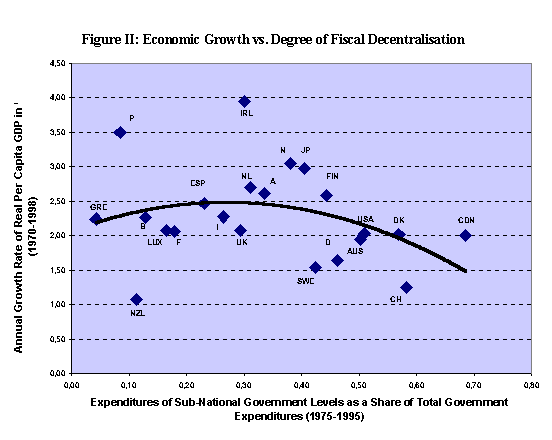
Source: Thießen (2000); Data: IMF (International Financial Statistics and GFS)